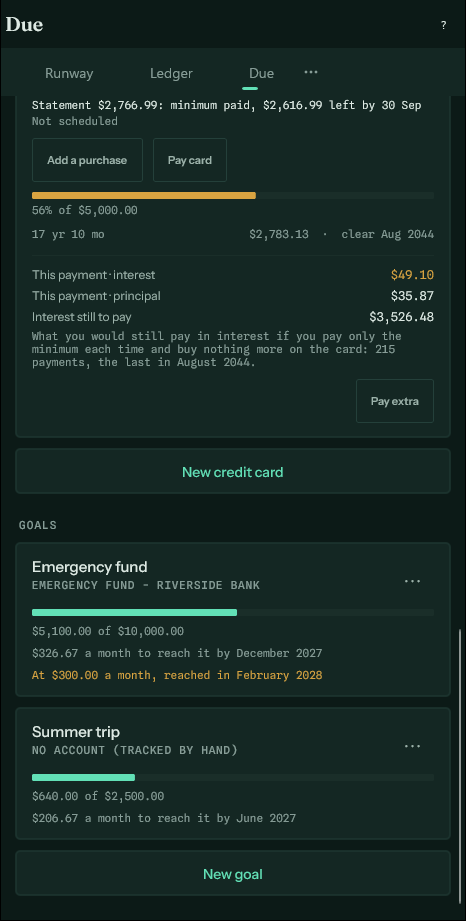
The Due screen
Everything already spoken for: recurring payments, and the debts behind some of them.
This is where the forecast comes from. Nothing else in the app knows what is coming; this screen is how you tell it.
Recurring payments#
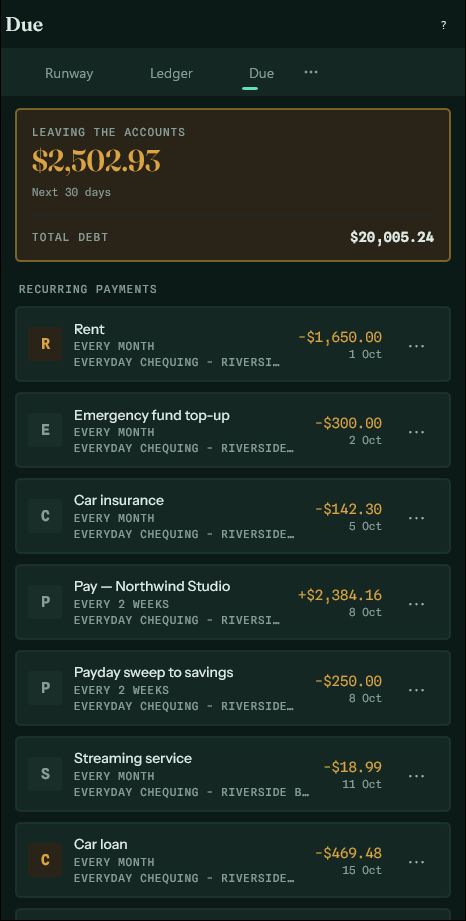
Anything that repeats: rent, a subscription, a salary landing. Each has an amount, a rhythm — every month, every two weeks, every 90 days, or twice a month on two set days — and an account it moves in or out of. Once entered, it writes itself into that account's ledger ahead of time.
- Twice a month is not every two weeks. It falls on the same two days of every month, the 1st and the 15th say, which is how many salaries are paid. A day past the end of a short month means that month's last day.
- On a weekend, a payment can stay where it falls, move back to the Friday, or on to the Monday. The next one is still due on its usual day.
- A bill that changes every time, like hydro, can be estimated: the forecast is the average of the last three amounts a statement confirmed, and a statement line close to it is offered as the same bill.
Pause one instead of deleting it when it is only stopping for a while.
Loans#
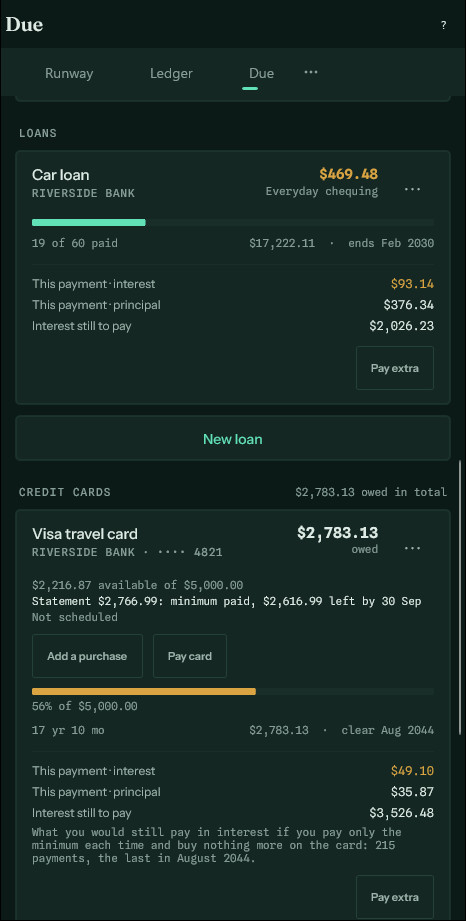
A loan is a recurring payment with arithmetic behind it. Give it the amount borrowed, the rate and the term, and the app works out the payment, splits every payment into interest and principal, and tells you the date the debt ends.
Each loan can also create its own recurring payment, so it shows up in the ledger like everything else.
Credit cards#
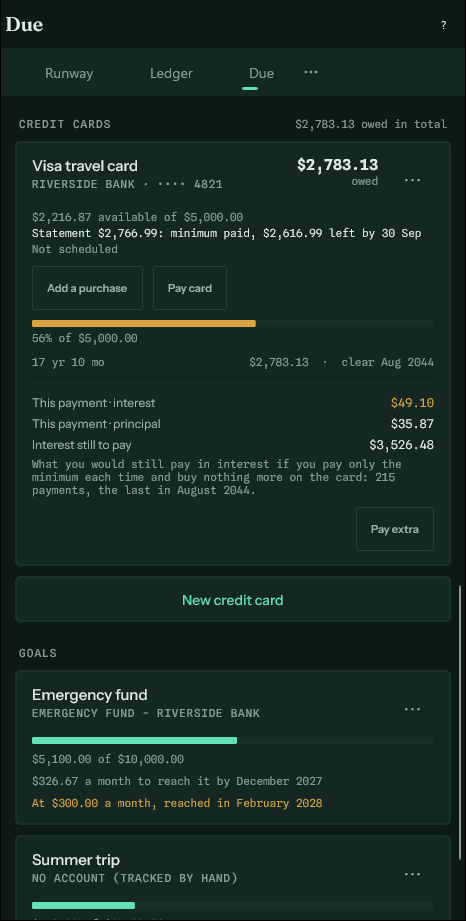
A card is set up the same way, and answers the question a statement never does: on this balance, at this rate, paying this much — when is it actually gone?
Give it the balance, the rate, and how you pay it: the minimum, or a fixed amount you have decided on. Whichever you choose, the card also tells you what the minimum alone would come to, because that is usually a decade further out than anyone expects.
What you buy with a card is recorded on the card, not in a bank account: Add purchase on its row on Due. Paying it off is Pay card, which moves the money from a bank account onto the card. Your bank balances only change when you pay.
Goals#
Money being put aside: an emergency fund, a trip, next year's insurance. Each goal shows how far along it is, what a month needs to reach it on time and, when it is saved into an account, where the pace your schedules actually set would get you.